
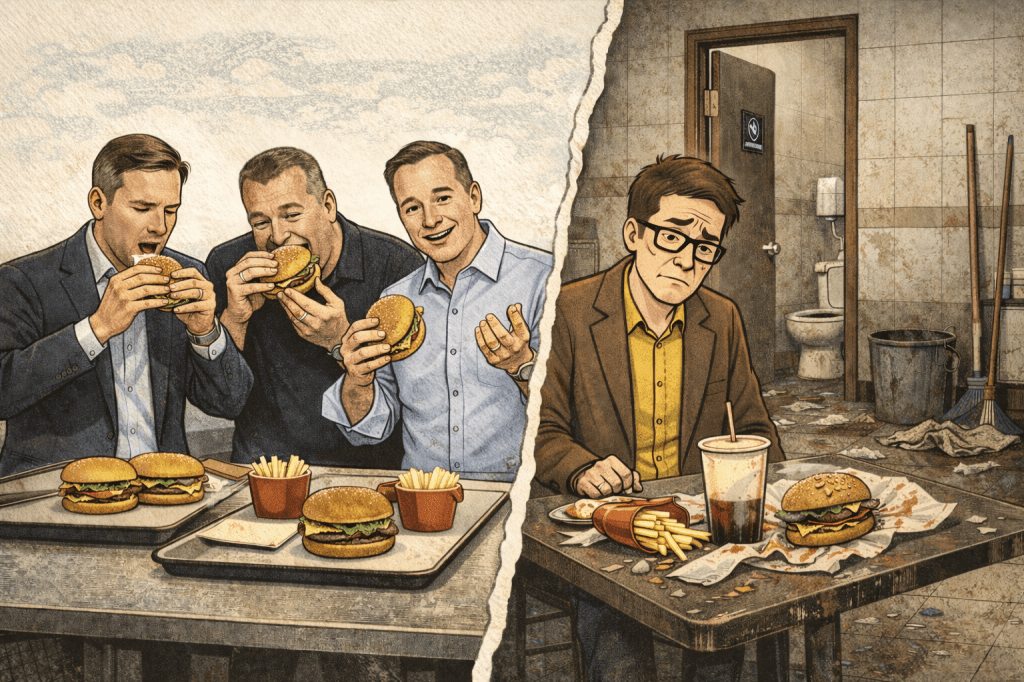
A new form of corporate marketing has quietly emerged across the fast-food industry: executives filming themselves eating burgers in an attempt to appear relatable to ordinary customers.
It began with the CEO of McDonald’s. Within weeks, Burger King executives were doing the same thing. Then Wendy’s leadership joined the spectacle. Even a spokesperson tied to A&W Canada has appeared in similar promotional content.
The idea seems simple enough. If the people running these companies eat the burgers themselves, it must signal confidence in the product.
But the entire exercise reveals something very different.
It exposes how distant the people running these companies have become from the people buying their food.
The McDonald’s CEO Who Looked Like He Had Never Seen a Burger
The trend started when Chris Kempczinski posted a promotional video eating the company’s new Big Arch burger.
In the clip he carefully lifts the burger, describes the “product,” and takes a small, cautious bite. The reaction online was immediate. Viewers joked that he looked like someone encountering a hamburger for the first time in his life.
The awkwardness was understandable. Kempczinski did not build his career flipping burgers in a franchise kitchen. His professional path runs through large corporate institutions including Procter & Gamble, Boston Consulting Group, PepsiCo, and Kraft before becoming CEO of McDonald’s in 2019.
His compensation reflects the scale of that position. Public filings regularly place his annual pay packages well into eight figures once stock and bonuses are included, often exceeding $15 million a year.
Watching someone who manages one of the largest restaurant corporations on Earth demonstrate how to eat a hamburger like a curious first-time customer struck many viewers as strange.
Burger King’s Executive Response
The moment the McDonald’s CEO video started circulating online, it didn’t take long for competitors to realize they had a marketing opportunity of their own. Instead of ignoring the awkward clip, Burger King chose to answer it. Tom Curtis, the company’s North American president, appeared in a video biting into a Whopper while joking that the only thing missing was a napkin. The message was obvious: while McDonald’s executives looked like they had never encountered a hamburger before, Burger King’s leadership wanted to show they were perfectly comfortable eating their own product.
The entire exchange felt less like food marketing and more like two corporations attempting to perform relatability for the internet. Curtis stood there with the burger, taking a confident bite, offering casual commentary, and projecting the sort of relaxed familiarity that the McDonald’s video clearly lacked. The goal was to look human, spontaneous, and unbothered by the camera.
Curtis himself is not the type of person most customers imagine when they think about someone grabbing a quick burger after work. His career spans decades inside the restaurant industry, rising through corporate leadership roles before eventually overseeing thousands of Burger King locations across North America. His job involves strategy meetings, brand management, and corporate operations on a massive scale. The world he operates in revolves around boardrooms, executive travel, and marketing strategy.
The average customer experiences Burger King very differently. They encounter it in drive-through lanes during a commute, after school activities, or during the familiar moment when the day has run long and cooking feels like one more obligation piled on top of everything else. The Whopper becomes less of a culinary decision and more of a practical one.
That contrast became even clearer in another video Curtis appeared in addressing a long-running customer complaint about Burger King burgers: smashed buns and soggy sandwiches that arrive looking nothing like the product photos. In the clip he discusses the issue while holding a Whopper, explaining that the company is working on ways to prevent burgers from arriving flattened inside the wrapper. The banter between the CEO and employee is hard to sit through, is definitely forced, and is everything most people hate about formal work environments. Worship corporate leadership or else…
It’s a strange conversation for a burger company that has been around for decades. Burger King has sold billions of burgers. Yet the problem of smashed sandwiches is suddenly being presented as though it were a newly discovered design flaw.
Customers have been complaining about this exact issue for years. Anyone who has opened a Burger King bag knows the experience. The burger inside often looks nothing like the photograph that sold it. The bun is compressed, the toppings have shifted sideways, and the sandwich arrives wrapped in paper that has already soaked through with grease.
Sometimes the result looks less like a carefully assembled meal and more like something that survived a minor car accident inside a paper wrapper.
Curtis appears calm and approachable in the video, speaking like a reasonable executive trying to reassure customers that the company is listening. He even comes across as fairly likable. But the idea that a global burger chain is now publicly addressing smashed Whoppers after decades of selling them highlights the same gap that made the McDonald’s CEO video feel so strange in the first place.
Wendy’s CEO Joins the Taste-Test
The next chapter came from Kirk Tanner, who publicly conducted his own taste test of the McDonald’s Big Arch burger.
Tanner’s career spans more than three decades inside large consumer-goods companies, including a long tenure at PepsiCo before eventually becoming CEO of Wendy’s.
Today he runs a company with thousands of restaurants worldwide and billions in revenue.
Executives at this level live lives built around option and convenience. Corporate travel, catered meetings, private offices, and homes worth millions are simply part of the professional landscape.
The average customer lives somewhere else entirely.
The Burger Executive Theater Reaches A&W
Once the executive burger videos began circulating, it was only a matter of time before the format spread beyond the biggest chains. What started as an awkward promotional moment quickly turned into a recognizable pattern across the fast-food industry. Companies realized that putting a corporate face in front of a camera with a burger in hand could signal confidence, authenticity, and a connection with the customer.
That logic has now reached A&W Canada.
A spokesperson associated with the company recently appeared in a promotional video enthusiastically presenting one of A&W’s burgers as if delivering a personal discovery. The tone is familiar by now: hold the burger up, take a bite, offer a few reassuring comments about how good it tastes, and project the idea that the people behind the brand are just as excited about the food as the customers.
The format follows the same logic driving the other videos circulating across the industry. If executives appear on camera eating the product themselves, the message is supposed to be simple: this food is good enough that the people running the company eat it too.
But the effect is almost the opposite.
By the time viewers see yet another corporate spokesperson carefully biting into a perfectly assembled burger, the pattern has already become obvious. The burgers look immaculate. The lighting is clean. The environment is spotless. Everything about the scene resembles a commercial production rather than the fast-food environment customers actually experience.
Real fast-food restaurants are loud, rushed, and often messy. Orders are assembled quickly, wrappers are greasy, and the burger inside the bag rarely looks like the one that appeared on camera moments earlier. The contrast between the polished promotional version of fast food and the everyday version customers encounter is difficult to ignore.
What began as a single awkward executive video has quietly turned into an entire genre of corporate marketing. Executives and spokespersons now stand in front of cameras demonstrating that they know how to eat the food their companies sell.
Instead of making the brands feel more relatable, the videos unintentionally highlight how distant the boardroom has become from the counter where the burgers are actually served.
The Reality of Fast-Food Life for Customers
For many people, fast food is not a nostalgic experience. It is the end result of the pace and stress of modern life.
It is the 25-minute commute through traffic where you pass six McDonald’s locations before even reaching the highway. It is driving home after your kids’ activities knowing dinner still needs to be figured out. It is opening the refrigerator and realizing cooking again tonight feels like another chore piled onto an already long day.
So the drive-through wins again.
Not because the burger is exciting, but because energy and time are limited.
The impulse to buy fast food is rarely nostalgia. It is the small surrender that happens when work, schedules, and grocery prices collide. It is the exhausted solution at the end of a day where cooking feels like one more obligation.
Watching multimillionaire executives casually take bites out of burgers in carefully staged promotional videos does nothing to bridge that gap.
The Restaurants People Actually Experience
The environments shown in these videos exist in a completely different universe from the restaurants customers actually visit.
Promotional clips show spotless kitchens, immaculate trays, and burgers that appear to have been assembled by food stylists. The lighting is perfect and the food looks almost sterile.
The reality inside many locations is far less cinematic.
Floors are sticky. Bathrooms are questionable. Parents teach their kids not to touch the sinks or sit directly on the toilet seats. Some restaurants look like a drug addict wandered in, diarrhea’d and vomited their last spin of meth onto the tile floor, and the staff simply had to keep the line moving.
Not fifteen feet away from those bathrooms, someone is assembling the burger executives insist online is absolutely delicious.
The interiors of many chains feel closer to prison common rooms than restaurants, built from steel and plastic so the place can be wiped down or hosed off between waves of customers.
Meanwhile the burgers in corporate videos look like museum displays.
It would not be surprising if they were assembled from entirely different ingredients than the ones sliding across counters in the real world.
What These Videos Actually Reveal
The irony of this marketing trend is that it unintentionally highlights how corporate the fast-food industry has become.
The brands that once sold themselves as neighborhood burger stands are now multinational corporations run by executives whose careers were built inside consulting firms and global consumer companies.
Watching those executives attempt to reconnect with ordinary customers through staged burger bites does not make the brands feel more authentic.
It simply exposes the distance between the people running these companies and the people standing in line at their counters.
The viral burger videos were meant to humanize the executives behind the brands.
Instead they reveal a simple truth about modern fast food: the people selling the burgers and the people buying them now live in entirely different worlds.

 Fat Wagner
Leave a comment