
Authored by Levi C. Webb
Airlines are steadily reshaping boarding procedures, pricing models, and passenger experience strategies as traveler behavior evolves alongside rising global instability, including the recent conflict involving Iran.
While the changes may appear incremental to passengers, industry data shows a coordinated shift in how airlines manage efficiency, profitability, and customer expectations in a more uncertain travel environment.
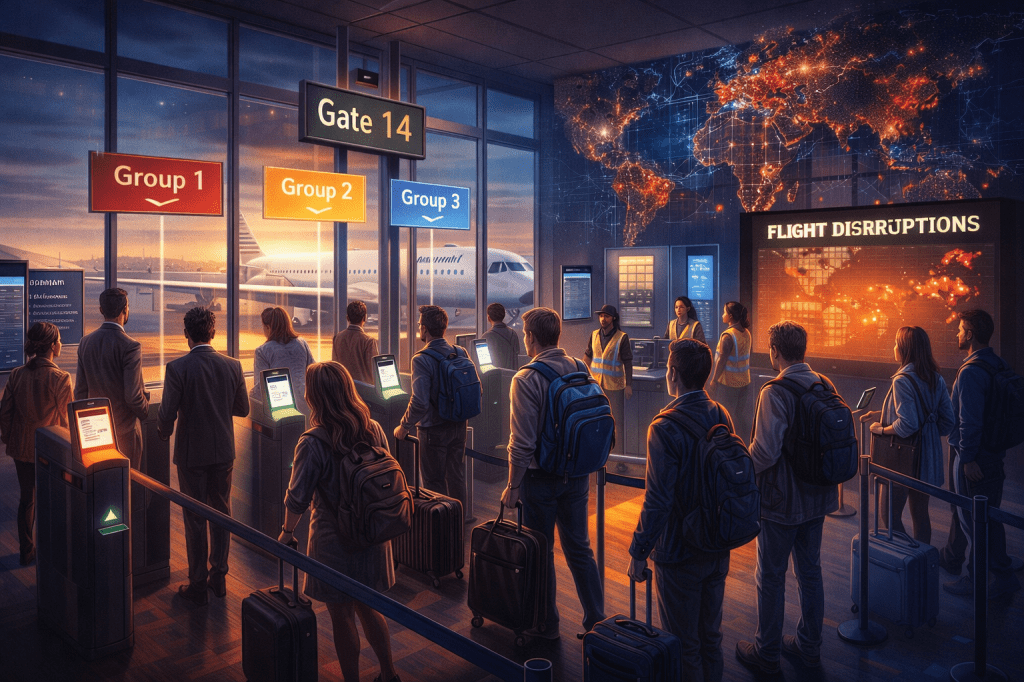
At the center of these adjustments is the boarding process itself. Airlines have increasingly leaned into structured boarding groups, enforcement technology, and revised sequencing strategies to reduce congestion and improve turnaround times. American Airlines, for example, has implemented gate scanning systems that alert staff when passengers attempt to board outside their assigned group, reinforcing order and reducing crowding at gates (Business Insider).
This focus on control reflects a broader operational reality. Studies of boarding behavior consistently show that inefficiencies stem from passenger interference in aisles and overhead bin competition, with carry-on luggage significantly increasing boarding times across all boarding methods (Diva Portal). Airlines are responding by tightening boarding structures and incentivizing earlier boarding tiers tied to ticket class and loyalty status.
At the same time, pricing models have become increasingly segmented. Airlines now rely heavily on tiered fare structures that separate the base ticket from add-ons like seat selection, baggage, and boarding priority. This approach aligns with broader industry findings that passenger decision-making has shifted toward cost transparency and customizable travel options (aas.modul.ac.at).
These structural changes are being shaped not just by economics, but by shifting global conditions. The recent instability surrounding Iran and broader Middle East tensions have contributed to fluctuations in fuel pricing, route planning, and traveler sentiment. While airlines rarely attribute consumer behavior directly to geopolitical events, industry patterns show that uncertainty tends to drive shorter booking windows, increased demand for flexible tickets, and hesitancy toward long-haul international travel.
This behavior aligns with broader passenger trend analysis from the International Air Transport Association, which notes that evolving traveler expectations are forcing airlines to continuously refine services and operational strategies to remain competitive (IATA).
Boarding itself has also become a reflection of modern airline economics. What was once a simple logistical process is now a tiered system that mirrors airline revenue priorities. Premium passengers, loyalty members, and those who pay for upgrades are granted earlier access, while standard passengers navigate increasingly complex boarding structures. Critics argue that this has introduced a visible class system into the boarding process, contributing to passenger frustration and competition at the gate.
Even airlines that historically resisted structured boarding are adapting. Southwest Airlines, long known for its open seating model, has begun transitioning to assigned seating and more formal boarding groups, signaling a broader industry alignment toward controlled, monetized passenger flow.
Operationally, airlines are under pressure to maintain efficiency in an environment where disruptions, staffing limitations, and fluctuating demand remain constant challenges. Boarding efficiency sits on the critical path of aircraft turnaround time, making it one of the most scrutinized aspects of airline operations (MDPI).
The result is an industry that is not undergoing a dramatic overhaul, but rather a steady recalibration. Airlines are refining systems at every touchpoint, from ticket purchase to boarding gate, in response to a traveler who is more cost-conscious, less predictable, and increasingly influenced by global uncertainty.
As geopolitical tensions persist and passenger expectations continue to evolve, these incremental changes suggest that the future of air travel will be defined less by innovation and more by precision—small, calculated adjustments designed to balance efficiency, profitability, and an increasingly complex passenger experience.
- • • • •
Reporting and writing by Levi C. Webb. AI tools were used selectively to assist with research and editorial support.
© 2026 Fat Wagner LLC. All rights reserved.


 Fat Wagner
Leave a comment