
Authored by Levi C. Webb
Large coffee chains continue to dominate the U.S. market even as independent shops and newer franchises attempt to compete for customers shaped by evolving social and consumption habits.
Coffee consumption in the United States has shifted from a simple daily routine into a layered social experience, where brand identity, convenience, and atmosphere all influence where customers choose to spend time and money.
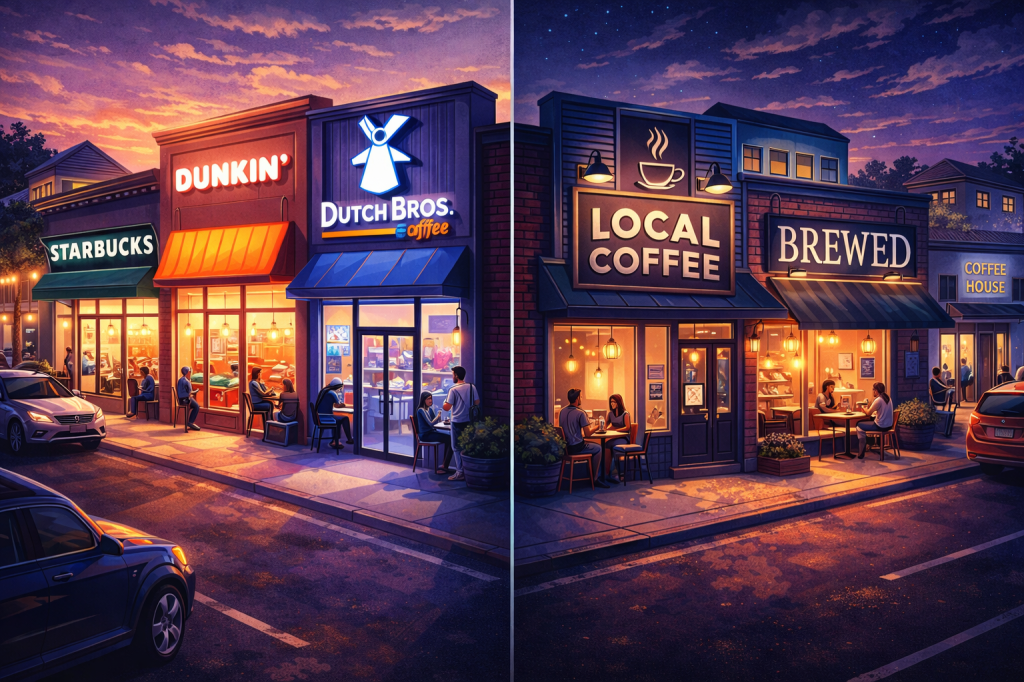
Major chains such as Starbucks, Dunkin’, and Dutch Bros have built extensive networks that prioritize accessibility and consistency, making them a default option for many consumers. Their ability to offer standardized menus, mobile ordering, and drive-thru convenience aligns with increasingly fast-paced lifestyles. This operational scale allows them to capture high-frequency customers who value predictability, especially during morning commutes and workday routines.
At the same time, these companies have transformed coffee shops into social spaces rather than purely transactional ones. Starbucks, in particular, has long positioned its stores as a “third place” between home and work, encouraging customers to linger, work remotely, or meet socially. This shift has helped reinforce customer loyalty, but it has also raised expectations across the industry for seating, ambiance, and digital connectivity.
Independent coffee shops have responded by focusing on differentiation, often emphasizing specialty roasting, unique drink offerings, and curated interior design. Many smaller operators aim to create distinct identities that appeal to local communities or niche audiences. In urban areas, this has led to the rise of boutique-style cafés that prioritize craftsmanship and atmosphere over speed and volume.
Despite these efforts, independent operators face structural challenges that limit their ability to scale or compete directly with larger brands. High commercial rent in both suburban and urban locations remains a significant barrier, especially in areas with heavy foot traffic. Smaller businesses also lack the purchasing power and supply chain efficiency of national chains, which can drive up costs and narrow profit margins.
Emerging franchise concepts have begun to occupy a middle ground between large chains and independent cafés. Brands like 7 Brew and Scooter’s Coffee are expanding rapidly by focusing on smaller footprints and drive-thru models, reducing overhead while still offering brand recognition. These models suggest that growth in the coffee market is increasingly tied to operational efficiency rather than purely product innovation.
For larger chains, growth brings its own set of challenges. Market saturation in some regions has made it difficult to expand without cannibalizing existing locations. Labor costs and staffing shortages continue to affect operations, particularly in high-volume stores. Additionally, some customers are seeking more personalized or locally oriented experiences, creating pressure on large brands to balance scale with authenticity.
Consumer expectations continue to evolve, with younger demographics placing greater emphasis on customization, sustainability, and overall experience. This has led to ongoing experimentation across the industry, from seasonal menu offerings to redesigned store layouts. Both large and small operators are adapting to these expectations, though their approaches differ based on scale and resources.
The U.S. coffee market remains highly competitive, shaped by a mix of convenience-driven consumption and experience-based preferences. While large chains maintain a dominant position, independent shops and emerging franchises continue to influence how coffee culture develops, ensuring that the industry remains dynamic rather than settled.
- • • • •
Reporting and writing by Levi C. Webb. AI tools were used selectively to assist with research and editorial support.
© 2026 Fat Wagner LLC. All rights reserved.



 Fat Wagner
Leave a comment