

Authored by Levi C. Webb
A quiet but measurable population shift is underway across Europe, as smaller cities and regional hubs begin attracting residents away from long-dominant urban capitals.
The shift is not theoretical. It is already visible in the numbers.
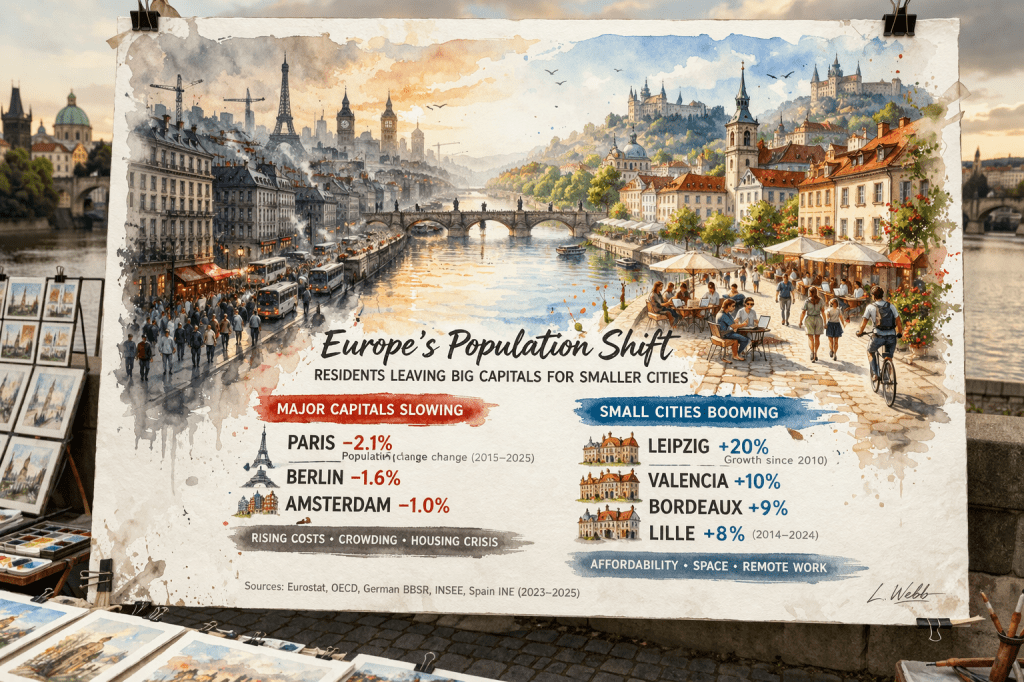
Data from Eurostat shows that population growth in many major European capitals has slowed significantly, while mid-sized cities are seeing steady increases (https://ec.europa.eu/eurostat/statistics-explained/index.php?title=Urban_Europe). In some cases, growth has reversed entirely among certain demographics, particularly younger families and remote workers.
Germany provides one of the clearest examples. Berlin’s population growth has cooled in recent years, while cities like Leipzig have surged. Leipzig’s population has grown by more than 20 percent since 2010, making it one of the fastest-growing cities in the country. According to Germany’s Federal Institute for Research on Building, Urban Affairs and Spatial Development, this growth is being driven by affordability and migration from larger urban centers (https://www.bbsr.bund.de/BBSR/EN/home/_node.html).
Housing costs are a major driver of that movement. Average rents in Berlin have risen by over 40 percent in the past decade, while cities like Leipzig and Dresden still offer significantly lower entry points for renters and buyers. This gap has created a powerful incentive for relocation, particularly for younger professionals who no longer need to be physically present in capital cities.
Southern Europe is seeing a similar pattern. In Spain, cities like Valencia and Málaga have experienced population growth rates of roughly 7 to 10 percent over the past decade, fueled in part by domestic migration and remote workers relocating from Madrid and Barcelona. The OECD has identified this shift as part of a broader trend where remote work is weakening the traditional link between job location and residence (https://www.oecd.org/urban/rural-development/remote-working-and-regional-development.htm).
France presents another clear case. While Paris remains dominant, cities like Lille, Nantes, and Bordeaux have absorbed significant population growth. Bordeaux alone saw population increases of nearly 10 percent over the past decade, driven largely by internal migration. According to the European Commission, housing affordability disparities between capital regions and secondary cities are now one of the strongest drivers of population redistribution (https://ec.europa.eu/regional_policy/en/information/publications/reports/2022/seventh-report-on-economic-social-and-territorial-cohesion).
The Netherlands is experiencing a similar decentralization effect. While Amsterdam continues to grow, government policies have actively encouraged population distribution toward cities like Utrecht, Eindhoven, and Groningen to relieve pressure on housing markets and infrastructure.
This movement is not just about cost. It reflects a deeper shift in how people define quality of life.
Smaller cities are marketing themselves around space, community, and access to nature. For many residents, the trade-off is no longer between opportunity and comfort. It is between density and balance.
At the same time, smaller cities are now dealing with the consequences of their own success. Rising demand is beginning to push up housing costs in places that were previously considered affordable. Local governments are under pressure to expand infrastructure, transportation networks, and public services at a pace they were not historically designed to handle.
The European Environment Agency has warned that rapid population inflows can strain local systems if growth is not matched by planning and investment (https://www.eea.europa.eu/publications/urban-sustainability-in-europe).
Meanwhile, major capitals are being forced to adapt. They remain economic and cultural centers, but their dominance as default living destinations is weakening. High costs, limited housing, and changing work patterns are reshaping their role in the broader urban ecosystem.
The numbers make one thing clear.
This is not a temporary fluctuation. It is a structural shift in how Europeans choose where to live.
The map is not collapsing. It is redistributing.
And cities that once sat in the shadow of major capitals are now becoming destinations in their own right.
- • • • •
Reporting and writing by Levi C. Webb. AI tools were used selectively to assist with research and editorial support.
© 2026 Fat Wagner LLC. All rights reserved.



 Fat Wagner
Leave a comment