
Written By Levi C. Webb
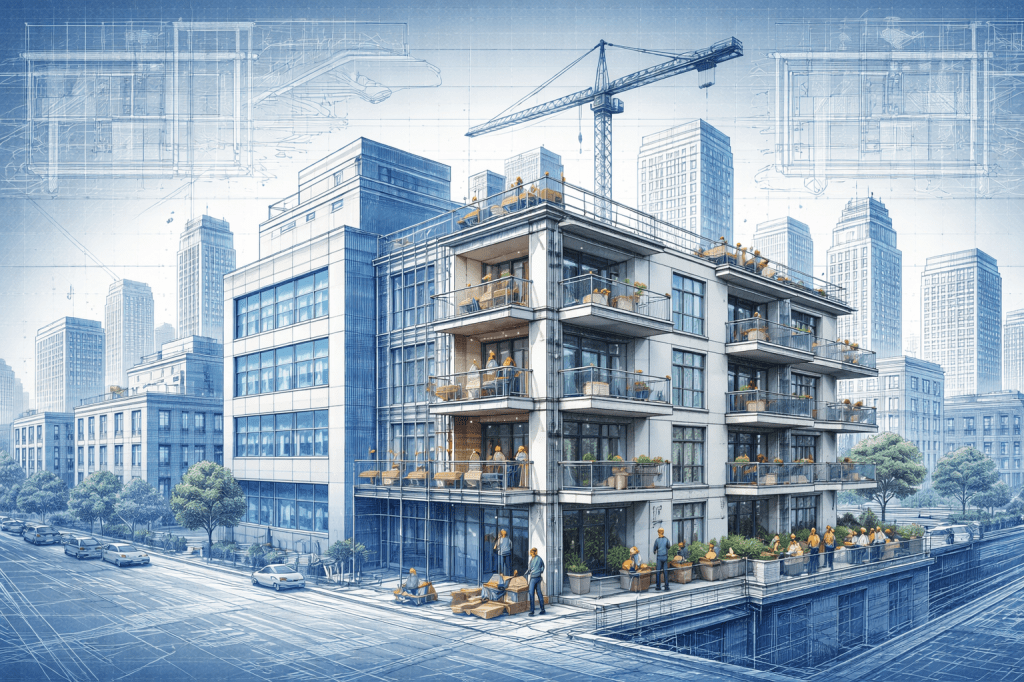
Cities across the United States are continuing to convert vacant office buildings into residential housing as remote work patterns keep downtown office demand below pre-pandemic levels.
Local governments are expanding support for office-to-housing conversions, reflecting ongoing efforts to address both elevated vacancy rates and persistent housing shortages in major urban centers.
The shift is being shaped in part by work-from-home trends that have proven more durable than many cities initially expected. Data from the Bureau of Labor Statistics continues to show a meaningful share of U.S. workers still telework or work at home for pay (https://www.bls.gov/cps/telework.htm), reinforcing the long-term impact of hybrid and remote schedules on office demand. That sustained change has left many downtown buildings underused and has increased pressure on cities to find productive new uses for aging commercial space.
New York City has moved aggressively to address the issue through its Office Conversion Accelerator, a program designed to help property owners navigate regulatory barriers and move projects forward more efficiently (https://www.nyc.gov/site/officeconversions/index.page). The city has also launched an Office Adaptive Reuse Task Force through its Department of City Planning to expand opportunities for converting obsolete office buildings into housing (https://www.nyc.gov/site/planning/plans/office-conversion/office-conversion.page). These efforts reflect a coordinated approach to treating vacancy as both a housing and economic challenge.
Chicago has taken a similar approach through its LaSalle Street Reimagined initiative, which focuses on transforming underused office buildings in the downtown financial district into mixed-use developments that include housing (https://www.chicago.gov/city/en/sites/lasalle-street/home.html). The program is part of a broader effort to restore activity in areas that have seen reduced foot traffic as remote work reshapes daily commuting patterns.
Los Angeles has also formalized this trend through its Adaptive Reuse framework, which allows for the conversion of existing commercial buildings into residential units under updated planning rules (https://planning.lacity.org/plans-policies/adaptive-reuse). City officials say the program is designed to increase housing supply while making use of existing structures, particularly in dense urban areas where new construction opportunities are limited.
Even with government support, these projects remain complex and often expensive. Many office buildings require significant redesign to meet residential standards for plumbing, ventilation, layout, and access to natural light. These structural challenges can limit which buildings are viable for conversion and often require cities to provide incentives or regulatory flexibility to make projects feasible.
The continued expansion of office-to-housing conversions highlights how cities are adapting to long-term changes in work behavior, as telework remains a defining factor in urban economic planning and downtown redevelopment strategies.
By Levi C. Webb
Reporting and writing by Levi C. Webb. AI tools were used selectively to assist with research and editorial support.
© 2026 Fat Wagner LLC. All rights reserved.


 Fat Wagner
Leave a comment