
Authored by Christian L. Gordon
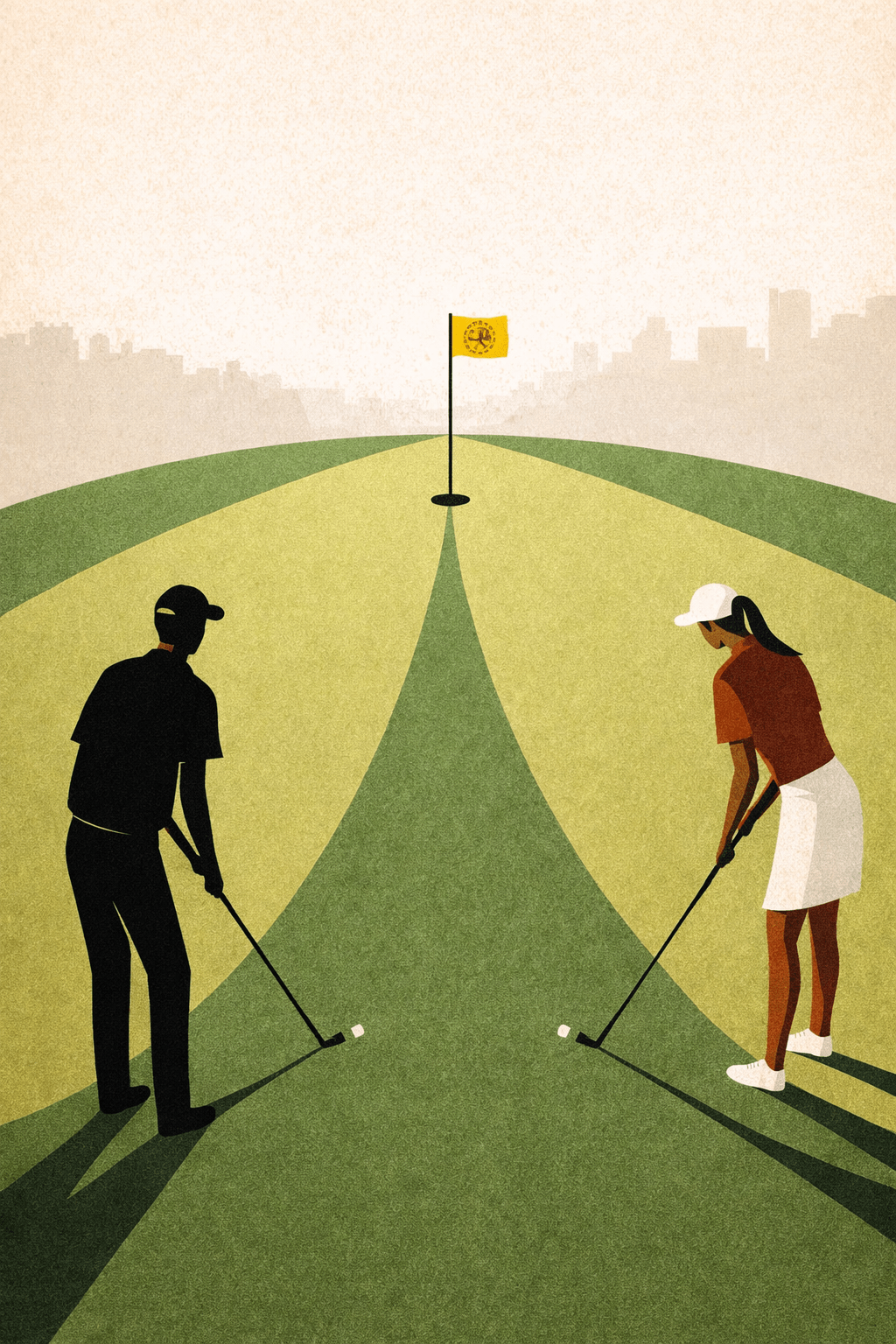
Two players at the top of the men’s and women’s game arrive this week carrying different expectations, but the same underlying advantage: control where others rely on risk.
The range at Augusta sounds different early in the week, quieter but sharper, with every strike carrying intent instead of volume as players settle into controlled repetition before competition begins.
Scottie Scheffler doesn’t stand out visually on the range, which is part of the point. His swing isn’t theatrical, his tempo doesn’t draw a crowd, and yet ball after ball lands with a consistency that feels almost procedural. What separates him right now isn’t distance or flair, it’s the ability to gain strokes tee-to-green without forcing aggressive lines. At Augusta, that matters more than almost anything else. The course doesn’t punish players for being conservative, it punishes them for being slightly wrong, and Scheffler’s game is built to avoid that margin.
Walking the practice areas, you can see how that translates in real time. Players are testing slopes, experimenting with trajectories, and adjusting to green speeds that are already approaching tournament pace. Scheffler moves through it differently. There’s less visible adjustment, fewer exaggerated rehearsals. His advantage isn’t adaptability in the moment, it’s arriving with a game that already fits the structure of the course. That’s why he continues to show up in contention without needing to chase it.
Across the broader landscape of the sport, Nelly Korda has established a similar kind of control on the women’s side, though it shows up differently. Her recent form has been defined by sustained stretches of clean golf, where mistakes are limited and scoring opportunities are converted without forcing momentum. She doesn’t rely on volatility to create separation, which is increasingly rare in a game that often rewards aggressive play. The result is a player who builds leads gradually instead of chasing them late.
That style creates a different kind of pressure. Korda’s position at the top isn’t built on highlight moments, it’s built on removing variables. When that works, it looks inevitable. When it doesn’t, it leaves very little margin to recover. That’s the contradiction that sits underneath her success. The same control that makes her dominant also means there’s less room to improvise if something breaks down. It’s a quieter form of dominance, but no less demanding.
Back here in Augusta, those differences in style become more visible when placed against the environment. The course is pristine in a way that feels intentional, almost insulated, while just outside the gates the contrast remains immediate. Inside, everything is calibrated—grass height, pin placement, movement of people. Outside, the rhythm is less controlled, less curated. That gap doesn’t impact how the tournament is played, but it does frame how it’s experienced.
By the time the crowds fully arrive, the narrative will simplify. Broadcasts will focus on contenders, momentum swings, and leaderboard movement. What gets lost is the underlying reason certain players keep appearing in those moments. Scheffler’s edge isn’t dominance in the traditional sense, it’s the absence of mistakes over time. Korda operates on a similar principle, building rounds that don’t require recovery. It’s less dramatic, but it’s more sustainable.
Watching both of them within the current state of the sport, the takeaway isn’t that they are untouchable. It’s that they understand where tournaments are actually won. Not in isolated shots, but in the accumulation of decisions that avoid unnecessary risk. That doesn’t make for loud analysis, but it holds up when the course tightens and the field compresses.
- • • • •
Reporting and writing by Christian L. Gordon.
Edited by Levi C. Webb
© 2026 Fat Wagner LLC. All rights reserved.


 Fat Wagner
Leave a comment