
Authored by Levi C. Webb
Scientists are identifying specific regions of the world’s oceans warming significantly faster than average, intensifying climate-related impacts on ecosystems and weather patterns.
Researchers are increasingly focusing on ocean regions that are warming faster than the global average, raising concerns about amplified climate effects on marine ecosystems and atmospheric systems worldwide.
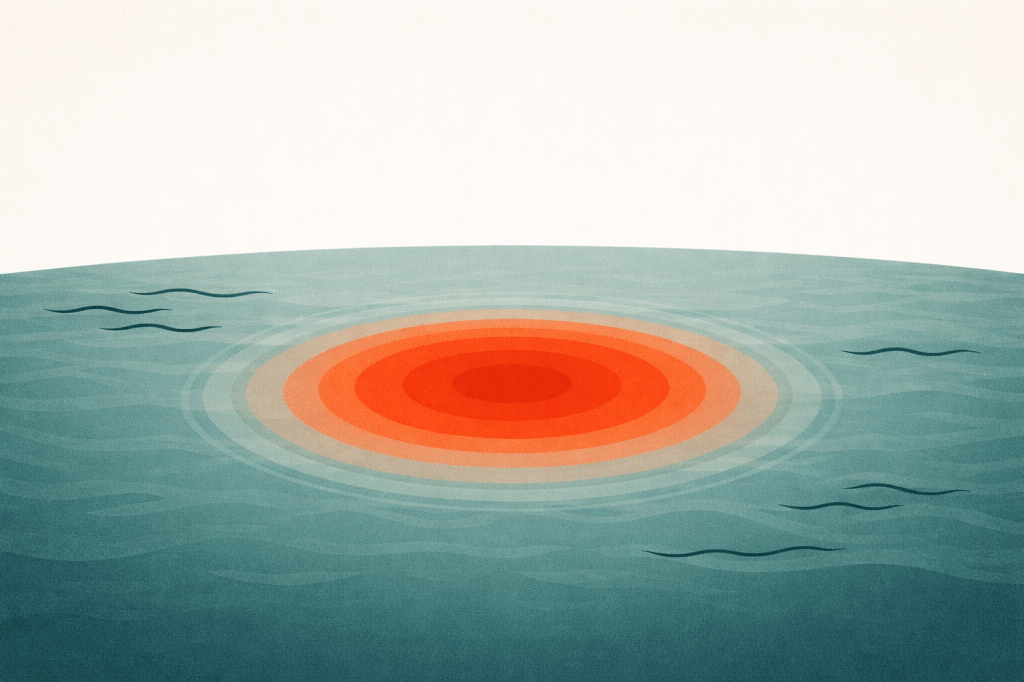
Recent scientific observations show that certain ocean regions, often referred to as “hotspots,” are warming at rates well above global averages. These areas are concentrated in parts of the North Atlantic, western Pacific, and Indian Ocean, where temperature increases are occurring more rapidly due to complex interactions between ocean currents and atmospheric conditions. The acceleration in warming is altering long-standing climate patterns that regulate weather and marine life.
The warming of these zones is having immediate consequences for marine ecosystems. Coral reefs, which are highly sensitive to temperature changes, are experiencing more frequent bleaching events in hotspot regions. Fish migration patterns are also shifting, with species moving toward cooler waters, disrupting local fisheries and food systems that depend on predictable ocean behavior.
Atmospheric impacts are also becoming more evident as ocean temperatures rise. Warmer ocean surfaces contribute to increased evaporation, which can intensify storm systems and alter precipitation patterns. Scientists have linked these warming zones to stronger and more erratic weather events, including heavier rainfall and prolonged drought conditions in different parts of the world.
The underlying causes of accelerated ocean warming involve a combination of greenhouse gas accumulation and natural ocean variability. Changes in wind patterns and ocean circulation are redistributing heat unevenly, allowing certain regions to absorb and retain more energy. This uneven distribution complicates global climate models, as localized extremes can produce outsized effects on global systems.
Researchers are expanding monitoring efforts using satellite data, autonomous ocean sensors, and deep-sea measurement tools to better understand these changes. Improved data collection is helping scientists refine projections and identify which regions are most vulnerable to continued warming. This information is critical for governments and industries that rely on ocean stability for economic and environmental planning.
Policy discussions are beginning to incorporate findings related to these hotspots, particularly in areas tied to fisheries management and coastal protection. Some regions are exploring adaptive strategies to account for shifting marine populations and increased climate variability. However, the pace of warming in these zones is raising concerns about whether mitigation efforts can keep up with observed changes.
The identification of rapidly warming ocean regions underscores the uneven nature of climate change and its expanding influence on global systems. As research continues, these hotspots are expected to play a central role in understanding future environmental and economic impacts.
- • • • •
Reporting and writing by Levi C. Webb. AI tools were used selectively to assist with research and editorial support.
© 2026 Fat Wagner LLC. All rights reserved.



 Fat Wagner
Leave a comment