
Authored by Levi C. Webb
Recent commentary crediting Disney-era pop figures with advancing artistic freedom overlooks decades of legal battles by metal and rap artists that established those protections.
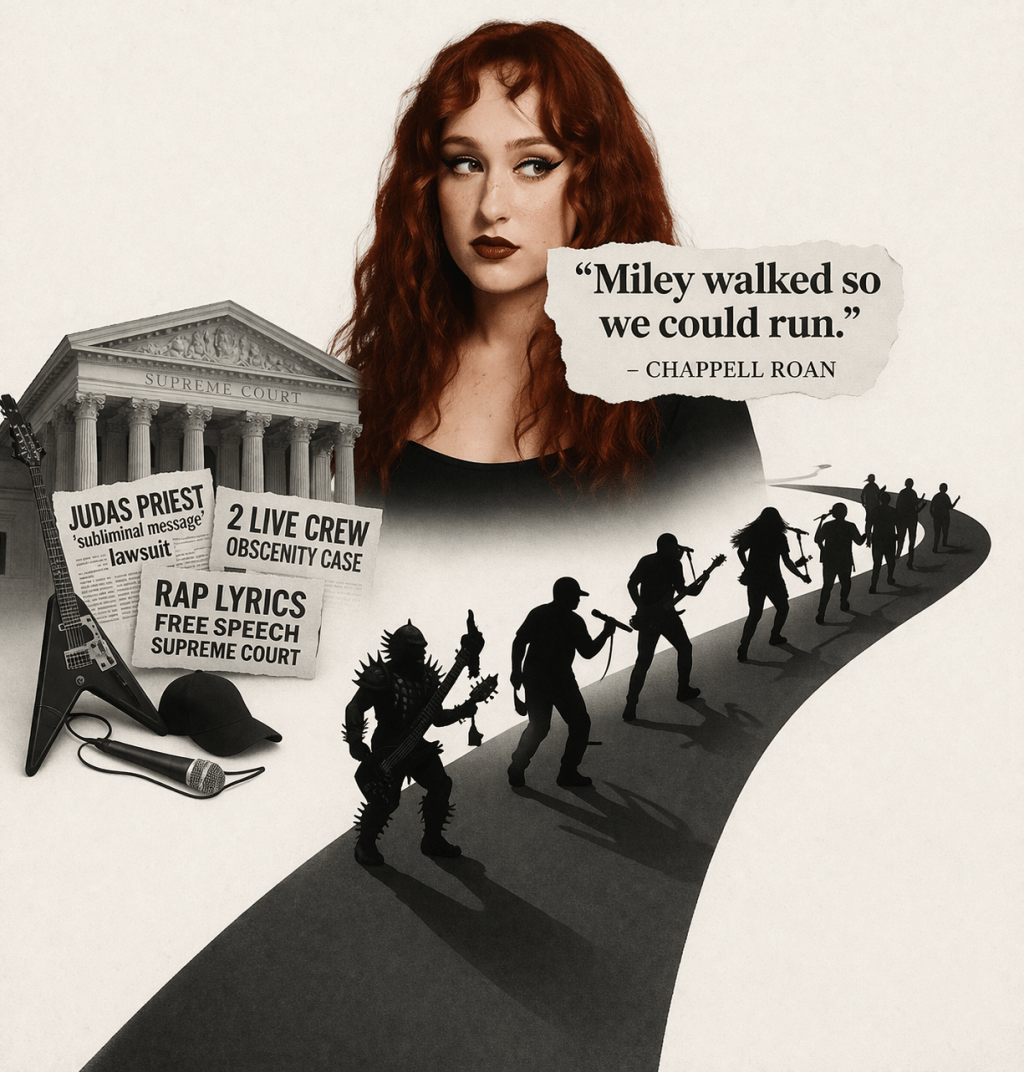
A viral statement from Chappell Roan praising Miley Cyrus as paving the way for modern artists has reignited debate about who actually secured creative freedom in music.
Roan’s comment that Cyrus “walked so others could run” in Disney’s Hannah Montana H20 20 year anniversary special reflects a widely used cultural metaphor that credits earlier figures with enabling later success, but its application to modern pop overlooks the legal groundwork laid by earlier generations. The phrase borrows a familiar moral logic from centuries long cultural movements such as the civil-rights narratives, earlier generations absorbing the hardest costs so later ones can move more freely, even though the wording itself is now a generalized cultural meme. While Cyrus represents a visible transition from child stardom to adult artistry, that shift occurred within an industry already shaped by prior legal fights over censorship, liability, and artistic control.
Those legal foundations were built through repeated courtroom challenges involving artists across genres, particularly in metal and rap. Judas Priest’s late-1980s civil case tested whether musicians could be held responsible for listener behavior, with the court ultimately rejecting that theory and reinforcing protections around artistic intent. Around the same time, 2 Live Crew’s obscenity trial in Florida forced appellate courts to examine how context applies to explicit music, resulting in a decision that strengthened First Amendment protections for recorded works. These cases established that controversial content alone does not meet the threshold for legal restriction.
Rap music, in particular, has continued to face scrutiny that has reached the highest levels of the U.S. legal system. Courts have repeatedly examined whether lyrics can be used as evidence in criminal proceedings, raising questions about artistic expression versus alleged intent. While the U.S. Supreme Court has not issued a sweeping ruling banning such use, it has addressed related issues around free speech and threatening language, reinforcing that artistic context matters in determining legal meaning. Ongoing debates involving artists such as those in the drill and hip-hop scenes show that the legal tension between expression and prosecution remains active rather than settled.
Body Count’s “Cop Killer” controversy demonstrated how political pressure can function alongside legal threats, influencing distribution and public reception even without direct court rulings. The backlash brought national attention to the intersection of music, law enforcement criticism, and free speech, showing that legal protection does not eliminate reputational or commercial consequences. That dynamic continues to shape how artists navigate controversial material today.
Performance-driven acts such as GWAR expanded the boundaries further by testing how far visual and theatrical expression could go within public decency laws. Their exaggerated stage imagery pushed local regulations without triggering consistent shutdowns, signaling that enforcement standards had shifted. This evolution reflected not a single legal victory but the cumulative effect of earlier court decisions that clarified the limits of censorship.
By the time Disney-affiliated artists began rebranding into more mature identities, the structural risks associated with controversial expression had already been reduced. The recurring pattern of child stars adopting edgier personas emerged within a legal environment stabilized by prior litigation, not as the catalyst for that change. Earlier artists, often without corporate backing or institutional support, absorbed the legal uncertainty that made later transitions commercially viable.
The broader history of music law shows a progression shaped by conflict, precedent, and cultural negotiation rather than singular figures. Roan’s statement aligns with a common narrative device that simplifies complex developments into individual milestones, but the underlying reality reflects decades of collective effort across genres. Understanding that timeline places modern artists within an established framework rather than at its origin.
- • • • •
Reporting and writing by Levi C. Webb. AI tools were used selectively to assist with research and editorial support.
© 2026 Fat Wagner LLC. All rights reserved.



 Fat Wagner
Leave a comment