
Authored by Levi C. Webb
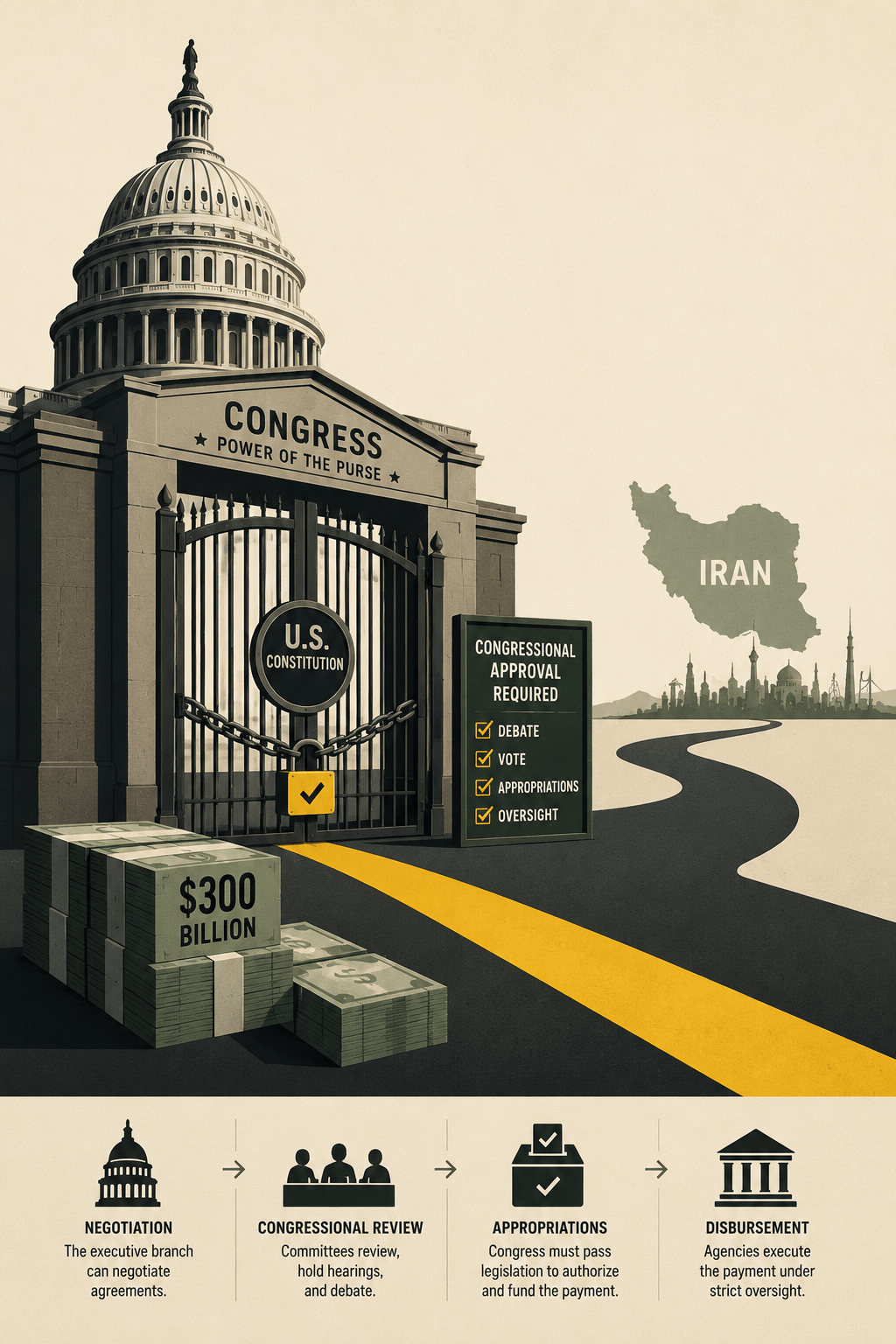
Under the U.S. Constitution, a president cannot unilaterally send $300 billion in taxpayer funds to Iran without Congress appropriating the money and federal agencies executing the payment.
Claims circulating online suggest the United States has agreed to provide Iran with $300 billion under a proposed memorandum of understanding. Even if such an agreement explicitly called for a direct taxpayer-funded payment, the process would be far more complicated than a presidential signature. The executive branch can negotiate agreements and make diplomatic commitments, but the power to spend federal money remains primarily in the hands of Congress.
The Constitution gives Congress control over federal appropriations through its power of the purse. In practical terms, this means that even if the president negotiated an agreement promising a foreign government hundreds of billions of dollars, Congress would still need to pass legislation authorizing and appropriating the funds. Without an appropriation enacted into law, federal agencies generally cannot legally spend money for that purpose.
A direct $300 billion payment would likely begin with the administration submitting a legislative request to Congress. Committees in both the House and Senate would review the proposal, hold hearings, debate the policy implications, and determine whether to authorize the expenditure. Members of Congress could amend the proposal, reduce the amount, attach conditions, or reject it entirely. Given that $300 billion exceeds the annual budgets of many federal departments, such a request would almost certainly face extensive scrutiny.
If Congress approved the funding, additional steps would still be required before money reached Iran. The Department of the Treasury, State Department, and other relevant agencies would develop mechanisms for disbursement and oversight. Depending on the structure of the agreement, funds could be transferred directly, placed into escrow accounts, released in stages, or conditioned upon verified compliance with specific requirements. Multiple layers of legal review and financial controls would normally accompany a transaction of that scale.
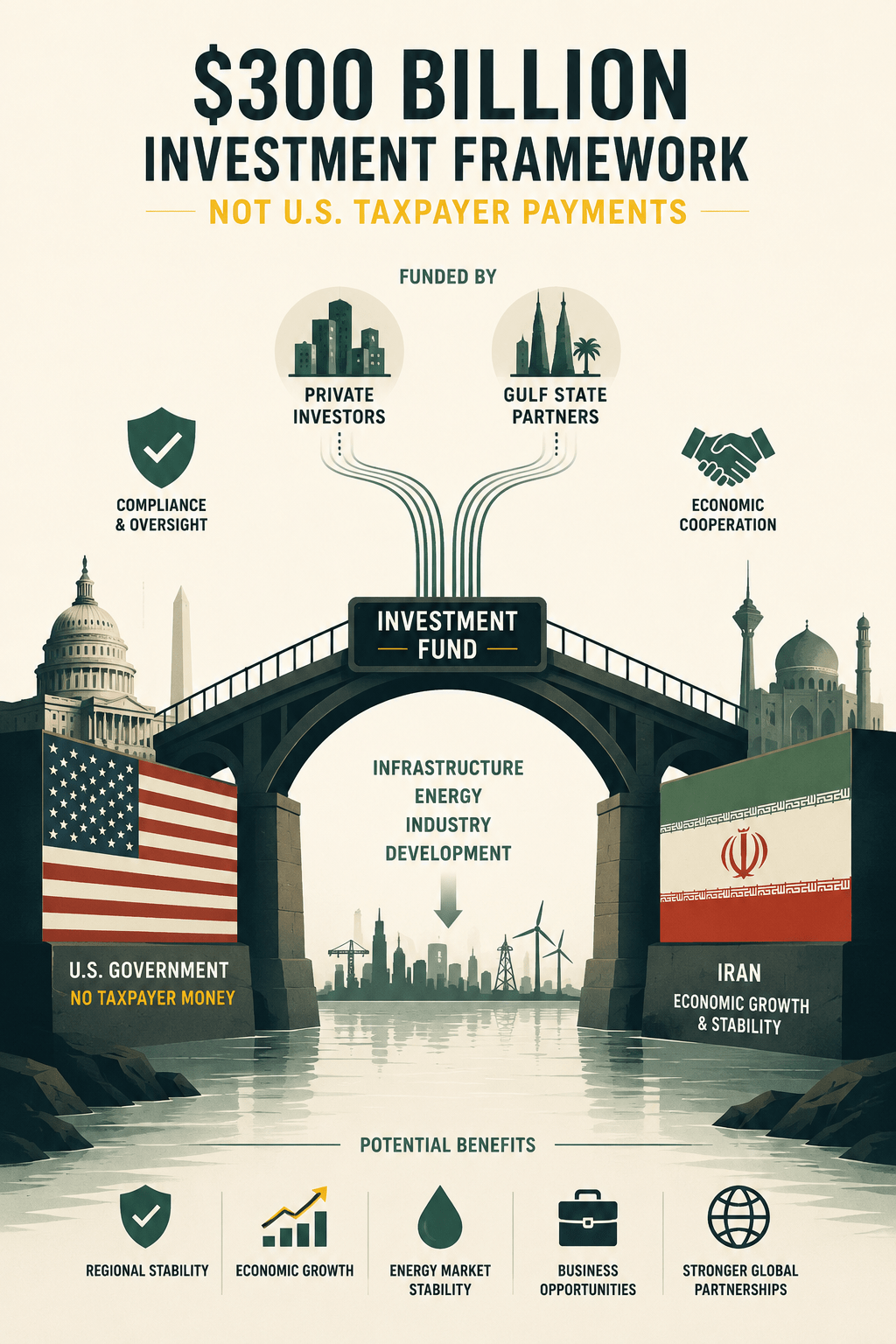
Recent reporting suggests the proposed Iran framework may not involve direct taxpayer spending at all. Reuters reported that the discussed $300 billion figure is associated with a private Reconstruction and Development Fund supported by private-sector investors and international participants rather than U.S. government appropriations. Reuters further reported that more than half of the proposed commitments are expected to come from private entities and that the vehicle would not include government grants or direct government funding. (Reuters)
Administration officials have publicly distinguished between taxpayer spending and private investment. Vice President JD Vance has stated that no American taxpayer money would be used and that any future investment mechanism would be funded by Gulf Arab states and private capital while remaining contingent on Iranian compliance with the agreement’s conditions. (New York Post) President Trump has likewise stated that the United States is not investing money in Iran as part of the current framework. (The Washington Post)
The distinction matters because private investment funds operate differently from federal expenditures. A private fund could involve investors voluntarily committing capital to projects such as energy infrastructure, transportation, manufacturing, logistics, or reconstruction efforts. Those investments would generally be made in pursuit of financial returns rather than as government aid. In such a model, the federal government’s role would be limited to diplomacy, sanctions policy, regulatory approvals, or facilitating international participation rather than writing checks from the U.S. Treasury. (Reuters)
Congress would still retain influence even if no taxpayer money were involved. Lawmakers could hold hearings, investigate the arrangement, pass legislation affecting sanctions, restrict executive authorities, or require additional reporting and oversight. Major foreign policy agreements often become political issues regardless of whether federal funds are directly appropriated.
The broader takeaway is that a memorandum of understanding and an actual federal expenditure are not the same thing. If a future agreement called for direct taxpayer-funded payments to Iran, Congress would almost certainly have to authorize and appropriate those funds before they could be legally spent. If the arrangement instead relies on private investment and foreign capital, the constitutional appropriations process would not apply in the same way because federal money would not be the source of the funding. Understanding that distinction is essential to evaluating claims that the United States has agreed to “pay Iran $300 billion.”
• • • • •
Reporting and writing by Levi C. Webb. AI tools were used selectively to assist with research and editorial support.
© 2026 Fat Wagner LLC. All rights reserved.


 Fat Wagner
Leave a comment