
Authored by Levi C. Webb
The Justice Department has expanded its beef-price investigation into major retailers, while the federal rules governing how farmers slaughter and commercially sell meat remain unchanged.
There is a meaningful new competition development, but not yet a new USDA/FSIS slaughter or inspection rule.
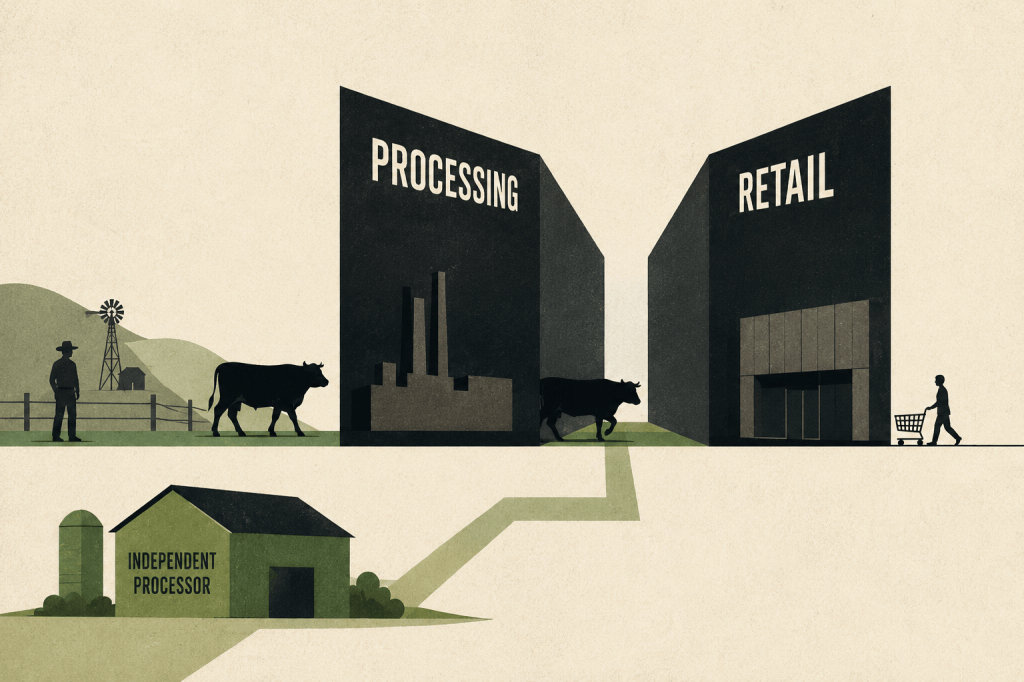
On September 2, 2026, the Justice Department expanded its beef-price antitrust investigation beyond the four dominant meatpackers and into the retail side of the supply chain. DOJ added Walmart, Costco, Amazon, Kroger, Albertsons, Aldi, Publix, and Ahold Delhaize USA to the investigation and has sought information concerning the surge in retail beef prices. The existing criminal investigation into large meatpackers, including Tyson, Cargill, JBS USA, and National Beef, remains ongoing. Those four companies slaughter about 85% of U.S. grain-fed cattle.
The expansion is significant because federal investigators are no longer examining only the highly concentrated processing portion of the beef supply chain. Investigators are now looking farther downstream at major retailers that purchase beef and ultimately determine what consumers see on grocery-store shelves. Examining both levels could help investigators determine whether unusual margins or potentially anticompetitive conduct are occurring primarily among processors, retailers, or at multiple points between cattle producers and consumers. An investigation itself does not establish wrongdoing by any of the companies involved.
For ranchers and small processors, however, nothing has changed yet in the actual federal slaughter rules. As of September 3, FSIS has not published a new rule broadly allowing farmers to commercially sell meat from livestock slaughtered on their own farms outside the existing inspection framework. Nor has the agency issued a rule broadly opening interstate commercial sales of custom-exempt meat. The FSIS Federal Register notice published September 2 concerned renewal of an information collection under the Paperwork Reduction Act and did not deregulate livestock slaughter or commercial meat sales.
That distinction matters because USDA is already taking other actions intended to expand competition among processors. The department opened $60 million in Phase 4 Meat and Poultry Processing Expansion Program grants this year, targeting additional processing capacity and more diversified supply chains. USDA also opened the Strengthening Processing for U.S. Ranchers program, or SPUR, with up to $500 million in temporary support for qualifying small, independent and midsize beef slaughter facilities. Importantly, SPUR eligibility itself illustrates the continuing regulatory framework: qualifying facilities generally must already be federally inspected or participate in specified cooperative inspection programs.
President Donald Trump has separately called for reducing barriers that prevent farmers and ranchers from processing more of their own products, while Agriculture Secretary Brooke Rollins has discussed expanding interstate sales, supporting smaller processors and eliminating regulations the administration considers outdated. Those statements point toward possible future regulatory changes, but they should not be confused with rules already in force. A farmer cannot treat a presidential policy announcement as authorization to bypass existing USDA inspection requirements for meat intended for ordinary commercial sale.
The administration is simultaneously trying to address high consumer beef prices through supply measures. An August 26 presidential proclamation temporarily increased the quantity of certain lean beef trimmings eligible for the lower tariff rate by 300,000 metric tons during 2026. The White House cited constrained domestic cattle supplies, continued consumer demand and USDA forecasts showing lower domestic beef production. That policy addresses near-term supply and pricing from another direction while the competition investigation examines conduct within the domestic supply chain.
The current picture therefore involves three separate federal approaches that can easily become conflated. USDA is financing and supporting smaller processing operations, the administration is signaling an interest in reducing regulatory barriers and increasing beef supply, and DOJ has widened its competition investigation from dominant processors into major retailers. None of those actions, as of September 3, amounts to the major regulatory change that would allow farmers to slaughter livestock on their farms and freely sell that meat commercially or across state lines outside the existing inspection system. If FSIS eventually changes those rules, that would represent a fundamentally different development for independent farmers and ranchers.
• • • • •
Reporting and writing by Levi C. Webb. AI tools were used selectively to assist with research and editorial support.
© 2026 Fat Wagner LLC. All rights reserved.

 Fat Wagner
Leave a comment